

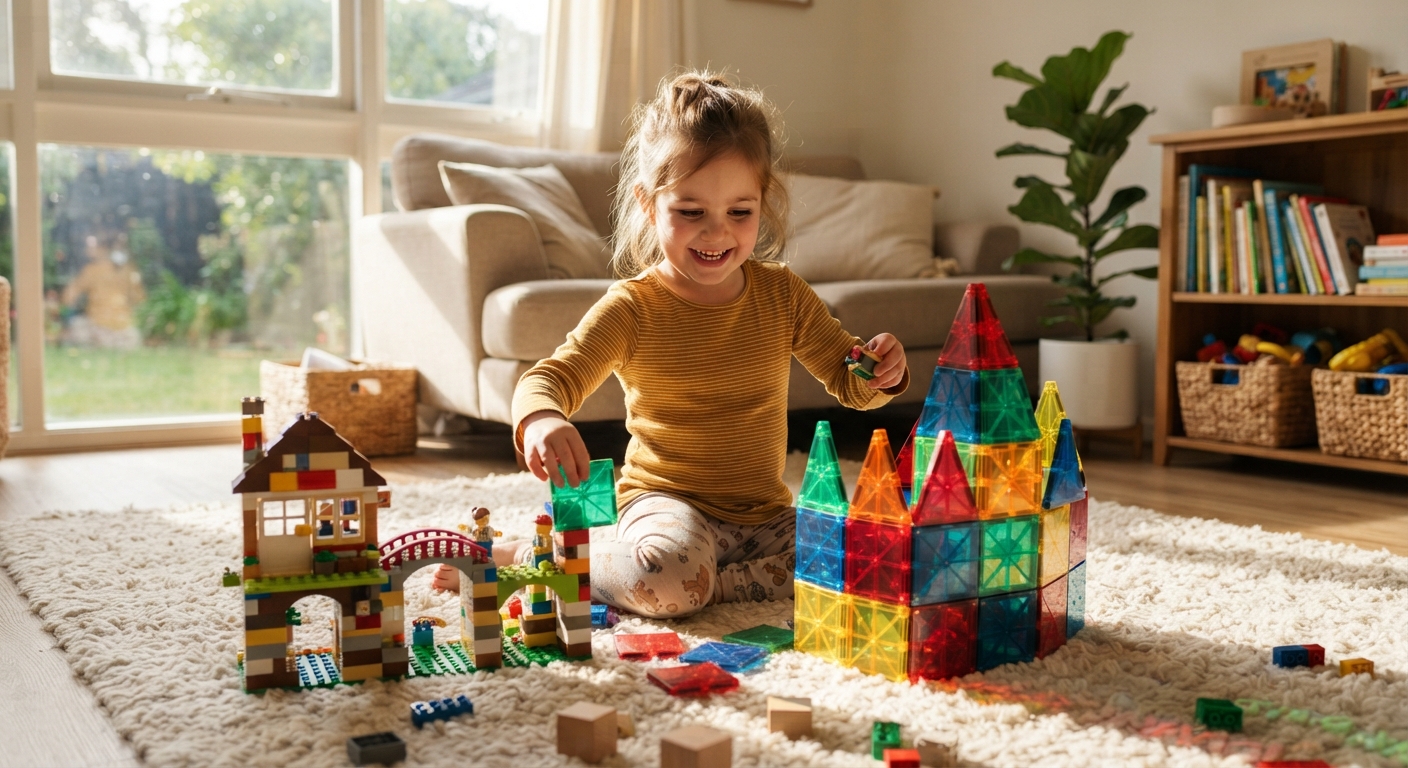
Introduction: The Ultimate Playroom Showdown
If you are looking to invest in a high-quality building toy for your child, you will inevitably face the ultimate playroom dilemma: should you go with classic interlocking bricks (like LEGOs) or modern magnetic blocks and tiles? Both are incredibly popular, both promise hours of educational entertainment, and both are considered essential tools for early childhood development.
However, while they both fall under the category of construction toys, they offer very different building experiences and developmental benefits. So, which one is actually better for your child’s growing brain? Let’s break down the pros, the cons, and the educational value of each to help you make the right choice.
The Case for Magnetic Blocks: Instant Gratification and 3D Thinking
Magnetic blocks and tiles have taken the toy world by storm in recent years, and for good reason. These colorful, translucent geometric shapes connect effortlessly via magnets embedded in their edges.
The Developmental Benefits of Magnetic Play
- Frustration-Free Building: For toddlers and younger children whose fine motor skills are still developing, magnetic blocks are a dream. They don’t require the physical strength or precision to snap together; they simply pull toward each other. This instant gratification keeps younger kids engaged for much longer.
- Mastering 2D to 3D Concepts: Magnetic tiles are perhaps the best toy for teaching geometry. A child can lay out a flat, 2D cross shape on the floor, and by pulling up the center, instantly transform it into a 3D cube. This is a massive leap for their spatial awareness.
- Understanding Magnetic Forces: Through pure trial and error, kids learn about magnetic polarity (attraction and repulsion). They quickly figure out that they sometimes need to flip a tile over to make it stick, introducing them to basic physics.
The Case for Interlocking Bricks (LEGO-Style): Precision and Patience
Interlocking plastic bricks are the undisputed classic of the toy world. From chunky blocks for toddlers to intricate architectural kits for older kids, these bricks rely on a friction-fit system to hold together.
The Developmental Benefits of Interlocking Bricks
- Advanced Fine Motor Skills: Pressing two interlocking bricks together—and, more importantly, pulling them apart—requires significant finger strength and precision. This repetitive action refines the “pincer grasp,” which is the exact muscle coordination needed for holding a pencil and writing later on.
- Following Instructions and Goal-Setting: While free-building is great, many interlocking brick sets come with step-by-step instruction manuals. Following these guides teaches children how to process information systematically, practice patience, and work toward a specific, delayed goal.
- Structural Integrity: Because the bricks lock tightly together, children can build highly complex, sturdy structures that won’t easily collapse if bumped. This allows for long-term projects and more elaborate engineering feats.
Head-to-Head Comparison: Which Should You Choose?
Still not sure which way to lean? Here is a quick breakdown based on common parenting factors:
- Age and Dexterity: If your child is between 2 and 4 years old, magnetic blocks are generally the winner. They are easier to manipulate and less frustrating. For children 5 and older, interlocking bricks provide the complex challenge their developing brains crave.
- Cleanup and Storage: Magnetic tiles naturally stack into neat, compact piles, making cleanup a breeze. Interlocking bricks, on the other hand, require sorting bins and are notorious for being a painful hazard if stepped on barefoot in the dark!
- Play Style: If your child loves open-ended, imaginative play (building a quick house for their action figures), magnets are fast and versatile. If your child is detail-oriented and loves creating permanent, intricate models, interlocking bricks are the way to go.
Why Not Both? Combining the Power of Magnets and Bricks
The truth is, you don’t actually have to choose just one. The absolute best playroom is one that offers a diverse range of materials. Switching between the easy, free-flowing creativity of magnetic blocks and the precise, challenging mechanics of interlocking bricks gives your child a well-rounded STEM education at home.
(Parent tip: You can find an amazing selection of both magnetic sets and interlocking brick kits in our Building & Construction Toys collection. Mix and match to create the ultimate learning environment for your child!)
Conclusion: The Real Winner is Your Child
So, who wins the great debate between Lego-style bricks and magnetic blocks? Your child does. Both toys are monumental in developing spatial awareness, engineering skills, and creative thinking. By providing your little one with either (or both!) of these fantastic tools, you are setting them up for a lifetime of curiosity and problem-solving. Happy building!