

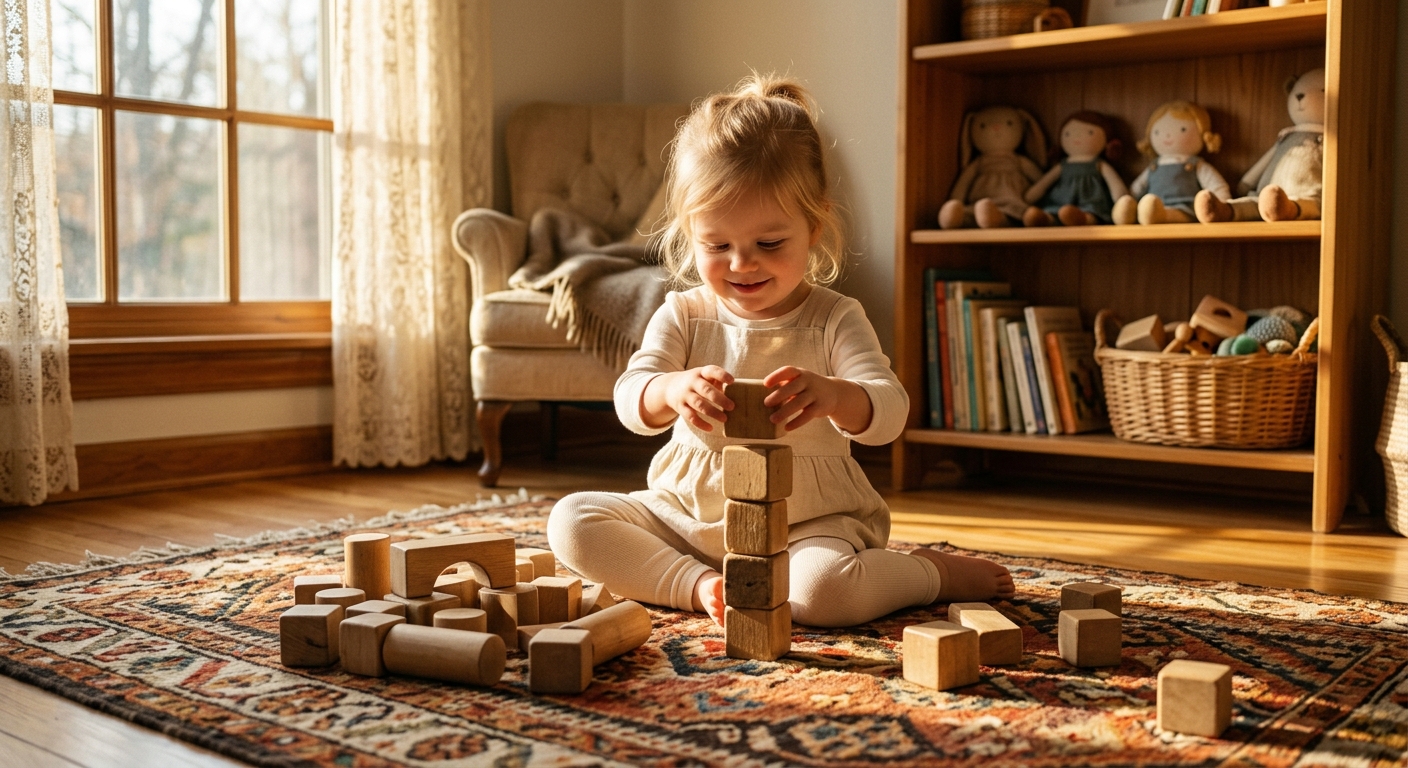
Introduction: The Timeless Appeal of the Simplest Toy
Walk down the aisle of any modern toy store today, and you will be bombarded by a sensory overload of flashing lights, electronic sounds, and toys that practically play with themselves. In an era where even toddler toys are connected to the internet, it is easy to overlook the humble, unpainted wooden or plastic block.
Yet, despite the rapid advancement of toy technology, classic building blocks remain a staple in preschool classrooms, pediatricians’ waiting rooms, and child psychologist offices worldwide. Why? Because these incredibly simple, battery-free shapes hold a secret: they are arguably the most powerful developmental tool a child can possess. Here is why every single child, regardless of age or interest, absolutely needs a set of classic building blocks in their playroom.
The Ultimate Open-Ended Toy: Zero Rules, Infinite Possibilities
Most modern toys are “closed-ended.” This means they have one specific function. A toy smartphone can only ever be a toy smartphone; it plays a pre-recorded song when you press a button, and that is it. Once the child figures out the mechanism, the toy quickly becomes boring and is tossed into the bottom of the toy bin.
Classic blocks, on the other hand, are the ultimate “open-ended” toy. They don’t come with instructions, they don’t have a designated top or bottom, and they certainly don’t have an off switch. A simple rectangular block can be a car zooming across the rug, a piece of pizza in a pretend kitchen, a brick in a towering castle, or a phone for making an imaginary call. Because the toy itself does nothing, the child is forced to do everything. This pure reliance on the child’s imagination is what keeps blocks relevant from infancy well into the elementary school years.
Building Brains: The Cognitive Benefits of Classic Blocks
When you watch a child stacking blocks, you are actually watching a brain building new neural pathways. Here are the specific cognitive skills they are developing:
1. Early Mathematics and Fractions
Blocks are a child’s first introduction to applied math. When a toddler discovers that two square blocks placed side-by-side equal the exact length of one rectangular block, they are discovering fractions and geometry. They learn to sort by shape and size, which is the foundation of mathematical logic.
2. The Laws of Physics and Gravity
Building a tall tower requires an intuitive understanding of physics. The child learns that placing a heavy, large block on top of a small, narrow one will result in a crash. Through trial, error, and many collapsed towers, they learn about weight distribution, balance, and gravity in a way that no textbook could ever teach.
3. Problem Solving and Resilience
When a block structure falls down, it is frustrating. But this frustration is a safe, necessary environment for learning resilience. The child has to stop, analyze what went wrong, and formulate a new plan to build a stronger foundation. This translates to real-world problem-solving skills.
Physical Development: Fine and Gross Motor Skills
Blocks are a full-body workout for young kids. Reaching, stretching, and crawling around a large block structure develops gross motor skills (large muscle groups). Meanwhile, carefully picking up a block and precisely balancing it on the very top of a wobbly tower requires intense concentration and fine motor control (small hand muscles). This hand-eye coordination is the exact skill they will need later for holding a pencil, writing, and using scissors.
(Parent tip: Ready to introduce the magic of blocks to your child? Browse our curated collection of Building & Construction Toys to find the perfect starter set for your little architect.)
Social and Language Skills: The Collaborative Build
While independent block play is fantastic, collaborative building is where social skills shine. When children build together, they are forced to negotiate, share space, and communicate their vision.
- “Can I have that long piece for my roof?”
- “Let’s put the red blocks on this side!”
Even if a parent is the building partner, narrating the process introduces a rich vocabulary of spatial and directional terms (over, under, next to, balance, support) that children absorb quickly.
The Ultimate Investment: Durability and Longevity
From a purely practical standpoint, classic blocks are the best investment a parent can make. Electronic toys break, batteries die, and plastic gears snap. A solid classic block, however, is nearly indestructible. It can withstand being thrown, chewed on, stepped on, and left outside in the rain. They are the rare type of toy that can be passed down from sibling to sibling, and even from generation to generation.
Conclusion: Back to Basics
In our rush to give our children the latest, most advanced toys, we often forget that child development hasn’t changed. Children still need to touch, manipulate, and explore the physical world to understand it. A set of classic building blocks provides a blank canvas for their imagination, a laboratory for their physical experiments, and a quiet, calming break from a screen-filled world. Sometimes, the simplest toys really are the best.